
Which bike should you choose for triathlon?
 © JMitchell
 Road bike, aero road rig or full-on TT bike? The best triathlon bike isn’t automatically the priciest, lightest or flashiest. It’s the one that fits your racing, your courses, and what you can actually hold and push. Here are the key points to weigh up before you decide.
In triathlon, the bike leg has a special place. It’s usually the longest part of the race, and a huge opportunity to save time. It’s also the discipline where the gear landscape has become genuinely complicated. Lightweight road bike, aero machine, time trial bike, deep rims, clip-on aerobars, 28/30/32 mm tubeless tyres, integrated cockpit… the options are endless, and the marketing talk can be hard to decode.
So, do you absolutely need a triathlon bike to do triathlon? No. Should you always chase weight? Not necessarily. Can a modern road bike be fast enough to take on a dedicated machine? In some situations, yes.
The right choice depends first and foremost on a multi-variable equation : your level, your budget, the distances you race, the course profile and, above all, your ability to hold an efficient aero position for the entire bike leg.
Before choosing a bike, choose your triathlon
This is probably the first piece of advice for any triathlete looking to invest: don’t pick your bike until you’ve defined what kind of racing you actually do.
A bike built for S or M triathlons with drafting allowed (very rare in amateur racing) doesn’t face the same constraints as a machine intended for an Ironman on a fast, non-drafting course. Likewise, someone preparing mainly for alpine races won’t have the same needs as an athlete targeting flat, windy courses.
If drafting is allowed, the case for a bike designed purely to maximise solo aerodynamics is less clear. Time spent in a group massively reduces aerodynamic drag and makes versatility and handling especially valuable.
If drafting is not allowed, as on most M, L and XXL races, everything changes. If you respect the rules, you’ll spend most of your time alone, potentially into a headwind. Aerodynamics then becomes a major performance lever.
The road bike: the most versatile option
For a first triathlon, a road bike is usually the most sensible choice.
You can train year-round, ride sportives, roll in a bunch and line up for pretty much any race. It’s also easier to transport, maintain and resell than a highly specialised machine. And it generally costs less, too.
But don’t think today’s road bike is the same as one from 10 or 15 years ago. Modern race bikes have made huge aerodynamic gains. Brands now work the tube shapes, cockpit, wheels, cable routing and integration of components all at once.
The best current race bikes have become true hybrids of low weight, stiffness and aerodynamics. Some deliver what used to require two bikes: a featherweight climber for the mountains and an aero model for fast courses.
Its main strength: versatility
A good road bike can take clip-on aerobars (when permitted) and become far more effective on fast, rolling courses.
It still offers a more natural position and better handling than a triathlon bike (i.e. a time trial bike). It’s also better suited to day-to-day training rides, rolling terrain and longer climbs.
Choose it if you:
Are new to triathlon
Race multiple distances
Ride outside of racing too
Do events with drafting
Prefer rolling or mountainous courses
Only want to own one bike
Its limitation: even when it’s very fast, a road bike usually won’t let you achieve as easily the ultra-low, ultra-stable aero position you can get on a tri/TT bike.
The aero road bike: the game-changing middle ground
Between the classic road bike and the TT bike, a third category has become hugely important: the aero road bike.
The goal is simple: reduce drag at higher speeds without completely sacrificing weight, comfort and versatility. Frames use optimised tube profiles, forks and seatposts are shaped to better manage airflow, and cockpits (stem + handlebar) are increasingly integrated.
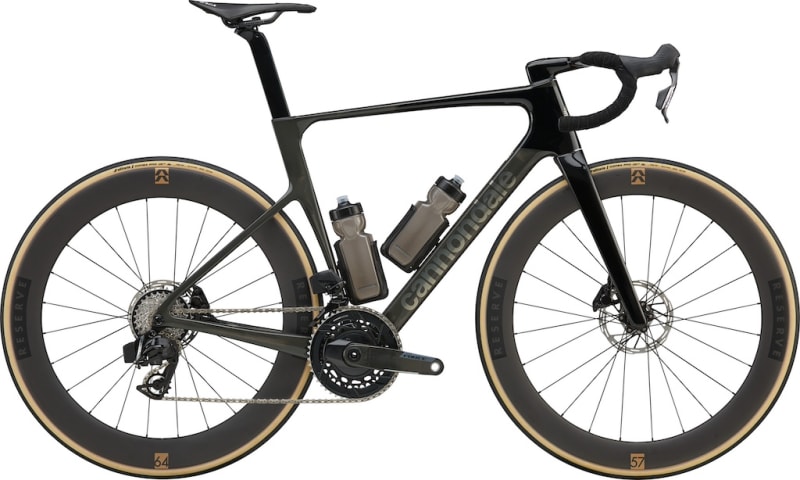
These bikes are especially interesting for triathlon because they match a simple reality: once you’re moving fast enough, air becomes the cyclist’s number one opponent. The faster you go, the more aero drag dominates. On a rolling course, a few extra km/h can cost far more energy than you’d expect.
And an aero bike no longer has to be a heavy bike. Current models aim to bridge both worlds. Advances in carbon layups and frame design now deliver machines that are very fast and still light enough to remain competitive on climbs.
Choose it if:
You want performance in non-drafting triathlons
Your courses are fast/rolling or rolling-hilly
You want a bike that’s also great for training
You want a balance of speed and versatility
For many triathletes, it’s probably the best all-round compromise today: a proper race bike that can still do everything.
The triathlon/TT bike: chasing the last few watts
A triathlon bike is far more specialised.
Its frame, cockpit and geometry are built around one priority: keeping the rider in an aero position for a long time.
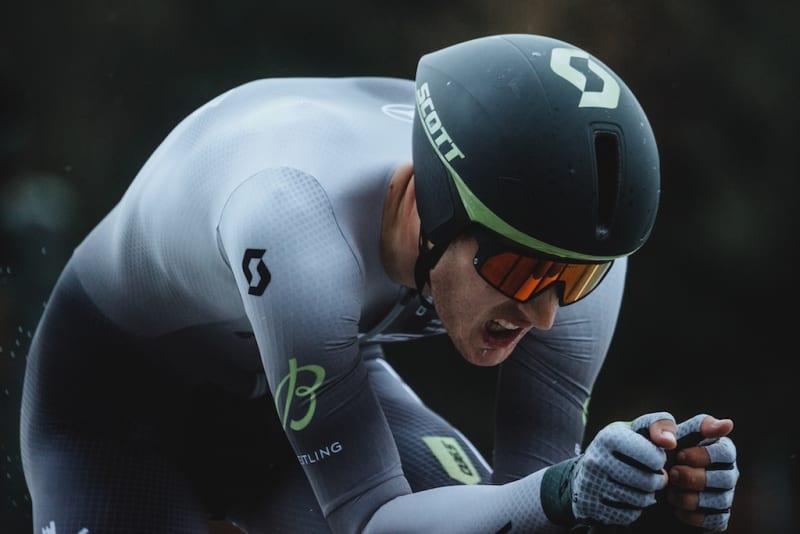
That point matters. The gain doesn’t come from the shaped frame alone. It comes from the whole system: the rider, helmet, suit, arms, legs, wheels and bike.
Aerobars bring your arms in, reduce frontal area and let you ride in a much more streamlined posture. But that position only works if you can hold it for tens of kilometres without wrecking power, breathing or comfort.
 © Chris Auld/SCOTT
That’s why a triathlon bike should never be chosen for looks alone.
A super-low position you can’t hold for four hours isn’t an effective aero position. Holding it for a long time requires proper setup to avoid injury, and training to make it sustainable.
Bike-fit studies and real-world fitting sessions all stress the need to balance aerodynamics, power and your ability to maintain the position over time.
Pros
Excellent aerodynamic efficiency
A position that shines on long fast sections
Highly integrated hydration and nutrition storage on some models
Ability to hold a very stable position over long distances
A real edge on non-drafting L and XXL triathlons
Cons
Less versatile
Less enjoyable in a group ride
Less practical on climbs and technical descents
Setup can be complex
More hassle to travel with and maintain
Often a significant investment
Choose it if you mainly race non-drafting triathlons and you’re chasing performance first and foremost on fast, rolling courses.
What about the mountains?
The old “lightweight bike vs aero bike” debate hasn’t completely disappeared, but it needs a different lens now.
Saving a kilogram on the bike obviously matters on a climb. But it has to be put in context against total system weight: rider + bike + kit + nutrition + water.
If you weigh 70 kg and your bike weighs 8 kg, dropping 500 g is less than 0.65% of total mass. The gain is real, but it’s relatively limited on most courses.
 © The Stone/Matteo Ostrabella
On the other hand, on a long steep climb, repeated several times, the power-to-weight ratio becomes decisive.
So a triathlete preparing for EmbrunMan, or any race with multiple long climbs, doesn’t necessarily benefit from choosing the most aerodynamic machine possible at the expense of weight and handling.
But don’t swing too far the other way either: buying an ultra-light bike while sacrificing aerodynamics isn’t automatically the smart move.
On a mixed course, the best choice can be a high-performance road bike that’s reasonably light with solid aero potential, rather than a machine that’s ultra-specialised in one direction or the other.
Tyres have changed the game
If one evolution has deeply reshaped race-bike design in recent years, it’s tyres.
The era of 23 mm tyres pumped rock-hard is over. Modern race bikes commonly run 28 or 30 mm, and some now clear 32, 34, even 35 or 37 mm.
At the 2026 Tour de France, an analysis of 26 tyres used by the pros showed an average real measured width of more than 30 mm, despite most being labelled 28 or 30 mm. Time trial bikes are still a little more conservative, but that gap is closing too.
Why the shift?
Because a wider tyre isn’t automatically slower.
At the right pressure, it can cut vibration losses and energy wasted on rough surfaces, improve grip, and help you carry more speed over imperfect tarmac. Wider rims have also changed how tyres shape up once mounted.
So the choice is no longer a simple showdown between “narrow tyre = fast” and “wide tyre = comfort”.
What you’re really after is the best compromise between width, pressure, casing, rim and road surface quality.
And for triathlon?
On a perfectly smooth, fast course, a relatively narrow setup can still bring an aero advantage depending on the tyre/rim pairing. On rough roads, a 28 or 30 mm can be exceptionally fast.
So tyre choice should be made with the wheel, not separately.
Actual measured tyre width can also differ significantly from what’s printed on the sidewall, depending in particular on the rim’s internal width.
Wheels: yes, but not at any cost
After the frame, wheels are probably the bit of kit triathletes dream about most.
A set of deep-section wheels instantly changes how a bike looks, and can deliver a real aero gain. But again, it has to be thought through based on the course and the rider.
Deep rims are generally more valuable at higher speeds and on rolling courses. But they can be more sensitive in crosswinds, heavier, and more expensive.
Very deep wheels or disc wheels can be extremely effective against the wind, but their value depends heavily on the weather, the course, and the rider’s ability to hold a stable line.
And above all, a wheel never works on its own. The tyre, rim width, fork and frame all influence how air moves around the whole system.
That’s why comparing two wheels solely by rim depth or weight doesn’t tell you much.
Position is often worth more than equipment
This is probably the most important point in this article. Before trying to buy a few extra watts with a new frame, ask yourself whether you’re actually getting the most out of what you already have.
On a triathlon bike, an effective aero position should let you:
Reduce the area exposed to the wind
Maintain enough power output
Breathe properly
Stay stable
Limit muscular tension
Hold that position for the whole race
And, above all, get off the bike with enough left to run well
 © ORCA
That last constraint is key in triathlon, and it’s what separates a triathlete’s logic from a pure time trial specialist. A slightly less aerodynamic bike that lets you hold solid power for four hours and then run properly can be faster overall than a theoretically superior aero machine that forces you to sit up regularly, shift around, or bleed watts.
That’s why a proper bike fit becomes a true performance tool.
What if you already own a road bike?
No need to change bikes straight away. A well-set-up road bike, with the right tyres, strong wheels and possibly clip-on aerobars, can make an excellent triathlon machine.
Before swapping frames, it can make more sense to work through, in order:
1. Position
Get your position checked, and your ability to stay on the aerobars comfortably.
2. Tyres
Choose a width and pressure that match your weight, your wheels and the road surface.
3. Wheels
If your course is fast and your budget allows it, a set of aero wheels can be a worthwhile upgrade.
4. Rider equipment
Helmet, suit, clothing and body position all have a big impact on overall aerodynamics.
5. Finally, the bike
In other words: before you buy a new €8,000 bike, make sure you’re truly using the potential of the one you already own.
So, which bike should you choose?
There’s no universal answer. If you’re starting out, buy a good road bike first. It’ll let you learn, train, and gradually understand what you need.
If you train and race triathlon regularly and want more performance, an aero road bike is a seriously appealing option now. The progress in this category has massively reduced the trade-off between weight, comfort and aerodynamics.
Finally, if performance is clearly your priority in non-drafting triathlons, especially L and XXL formats, and your courses are fast enough, a triathlon bike is still the benchmark. It lets you push position and aerodynamics further. But whatever you choose, keep one rule in mind: the fastest bike is the one you can stay fast on.
A superb frame, €3,000 wheels, a fully integrated cockpit and the latest tyres will never make up for an uncomfortable position, low power, or poor pacing. The real goal isn’t to buy “the bike that’s the fastest”. It’s to build the most efficient system between your body, your position, your bike and the course.
And in that system, the engine is always the same: you.