
 © Korupt Vision/IRONMAN
Pierre Le Corre ahead of the 2026 IRONMAN World Championship in Hawaii: “I want to write one last chapter in long-distance triathlon”
Pierre Le Corre has done it all on the triathlon circuit: a WTCS win, a European title, a mixed relay world title and fourth place at the Paris 2024 Olympics. After 15 years racing Olympic-distance triathlon, he decided to take on the legendary IRONMAN distance. Finishing second in his first IRONMAN at the start of the season, the athlete from Vannes secured his Hawaii qualification, somewhat to everyone’s surprise. At 36, he will be one of the race’s rookies this Saturday, October 10, and is primarily looking to gain experience so he can come back better prepared to take on the challenge in the years ahead.
Pierre, why did you choose long-distance triathlon and IRONMAN?
Because within the French Olympic team, the younger athletes were really starting to push from behind. I know how difficult it is to make that team, how deep the field is, and I still wanted to keep racing at the highest level.
I had spent 15 years racing the Olympic distance, and I think I’d done pretty much everything I could on it. I felt it was time to try something else while staying at the top level. IRONMAN and long-distance racing suited me quite well because they’re endurance events, and as I get older, that’s almost a better fit for me.
Was it also a way to bounce back after the frustrating Paris 2024 Olympics?
I arrived at the Paris Olympics in the best shape of my life and at my highest level. I have no regrets about that, but I was certainly short on luck and opportunities, with the various crashes in my races. Things could really have gone my way, but circumstances meant that they didn’t.
It took me a little while to process it, but I told myself I’d been lucky to get that far. Short-course triathlon is a discipline shaped by the unpredictable nature of racing, with a lot of risk-taking, and sometimes it comes down to almost nothing. So I was still happy with my preparation and the level I had reached.
2025 was then a strange year when I wasn’t really sure what I wanted to do. I raced a bit of long-distance and a bit of short-distance, and I also got injured at the worst possible times. It became a transitional year, trying to figure out what I wanted. Eventually, it became obvious: my short-course career was over, and I still wanted to write one last chapter in long-distance racing. The goal was to qualify for Hawaii and experience it.
 © Janos Schmidt / World Triathlon
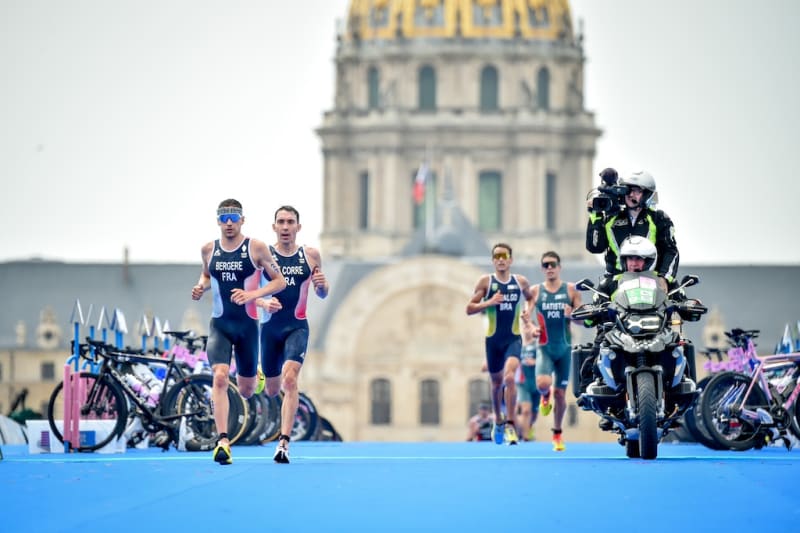 © Janos Schmidt / World Triathlon
You were the 2022 long-distance triathlon world champion. Had you always been drawn to long-distance racing?
Because I wasn’t selected for the Tokyo Olympics in 2021, I had already wanted to move into long-distance triathlon, and I started putting together some strong results in 2022. But in reality, I continued to perform well over the Olympic distance after Tokyo and eventually qualified for Paris 2024.
Olympic triathlon is shaped by the unpredictable nature of racing. There’s a lot of risk-taking, and sometimes it comes down to almost nothing.
You made an impressive IRONMAN debut at the start of 2026, finishing second at IRONMAN New Zealand after just two weeks of specific training…
Yes, and it surprised me because I fractured my ribs at the end of 2025 and had to stop training for more than two months. So my preparation for my first IRONMAN was very limited, and I was surprised by the level I showed in Taupo. It won’t be the same level this weekend in Kona, of course, but in New Zealand I didn’t expect to be racing at the front with that much ease. I never felt I was pushing hard that day.
 © KMSP / CNOSF
Did you choose that date and race because it offered an early-season opportunity to qualify for Hawaii?
No, at first it was much more about travelling. We wanted to spend some time in the Southern Hemisphere and take advantage of the racing opportunities available at that time of year. I had no intention of qualifying for Hawaii at that race, given how limited my preparation was. I went without any target placing in mind, focusing more on tactical and strategic goals because I was discovering the distance.
 © Korupt Vision/IRONMAN
 © Fiona Goodall/IRONMAN
 © Fiona Goodall/IRONMAN
 © Korupt Vision/IRONMAN
Is it a different sport from the one you practised over the short distance?
Completely. IRONMAN 70.3 isn’t that far removed from Olympic-distance triathlon, but IRONMAN is another world. You really need a specific approach to the format. I found it very difficult to prepare and do IRONMAN-specific training. After years of following a very precise training approach for Olympic-distance triathlon, I had to change everything, and adapting was hard. Looking at my new rivals here in Kona, I realise I haven’t necessarily done the same sessions as them. I’m still very much learning.
The level in Kona this year is something we’ve never seen before. I can feel that it’s going to be very, very fast. You can’t listen too much to your body, but not listening to it also means risking blowing up and not finishing.
What does that mean in practical terms?
It means doing long, even very long, sessions at IRONMAN pace, with the right nutrition and plenty of carbohydrates. That’s something I’ve clearly struggled with, partly because it isn’t necessarily what I want to do. It’s a bit of a paradox.
You also have to prepare mentally to handle that kind of volume. It isn’t necessarily very hard physically, but it’s very long and takes the whole day. You set off carrying sugar on your back and you eat nothing but sugar, so it’s a strange experience. Naturally, I’ve done a few sessions like that, but not many.
How did you build your season once you had qualified for Hawaii?
Since June, I’ve focused my entire end of season on Hawaii, mainly to try to arrive fresh. I haven’t raced much to preserve that freshness, apart from Yotta XP de Vichy, IRONMAN 70.3 Swansea in Wales, where I finished fifth, and the Triathlon XL de Gérardmer in France, where I finished second. I was able to test some of the equipment I’ll be using in Kona.
What are you expecting from this IRONMAN World Championship?
I’m not really sure, to be honest (laughs). I’d like to finish the race first and put together a complete performance. Maybe even race with the other guys, although the conditions can be really, really tough.
 © Korupt Vision/IRONMAN
 © Korupt Vision/IRONMAN
Do you think you can go toe to toe with the top specialists?
The level this year is unprecedented. All 55 professional athletes are very, very strong, it’s going to be fast, and I’ll have to avoid burning myself out. If you’re racing above your limit, you’re not going to finish. So I don’t want that to happen. I want to finish with a strong, controlled marathon, while still staying reasonably close to the front of the race.
It’s a difficult race to approach because I can feel it’s going to start very, very fast, and you can’t listen too much to your body. But ignoring it also means risking not finishing. The aim is to stay toward the front, or at least in the middle of the pack, let the big cyclists ride away, hold my own pace and then run a good marathon. I’m not chasing a result. My data, heart rate and power will dictate my pace, and I’ll work with those numbers to make sure I get to the finish line.
I’ll have to be patient and ride the limit.
Is there anything in particular you’re worried about in this race?
Clearly, going above my limit and never being able to recover. Once your heart rate passes a certain threshold, the only way to bring it back down is to stop. And stopping means losing your race.
You’ve discovered Kona and its surroundings. What struck you?
It’s huge and majestic. The wide roads and long straight sections on the bike are impressive. The heat, combined with the humidity and UV exposure, is tough to handle. You really realise you’re on a volcano. I’ve checked out some of the key points on the course, including Energy Lab. We were there in the middle of the afternoon in extreme conditions. It’s very, very hard, and difficult to run fast there. You’ll have to be patient and know how to ride the limit. I think there will be a lot of attrition this year. Everyone will want to make their move at some point, and I expect to see a lot of blow-ups.
 © Thomas Devard
 © Thomas Devard
 © Nigel Roddis/IRONMAN
Was this a race you had marked down when you started triathlon?
Actually, I discovered triathlon through Hawaii. I was in Philadelphia in 2006 on an exchange programme. The television showed footage of the race, along with reports about people who had been through difficult times in their lives and were taking on this sporting challenge. That was how the race was presented back then, and that’s how I discovered it. When I became a triathlete, it was always a race I wanted to put on my to-do list. So I’m happy to be able to tick it off… Well, I hope I can.
Will this be a one-off, or are you already thinking about coming back?
If I can come back next year, that would be great. This year, I want to gather as many reference points as possible, understand what the race demands, especially in physical and physiological terms, because I’m arriving a little underprepared compared with many of the other athletes. Then I could come back next year with a better strategic plan, better equipment, too, and put together a stronger race.
PIERRE LE CORRE AT A GLANCE
Born March 3, 1990, in Vannes
Club: Yotta Team, Les Sables Vendée Triathlon
Career highlights
Fourth at the Paris 2024 Olympics
25th at the Rio 2016 Olympics
Winner of WTCS Sunderland 2023
Winner of IRONMAN 70.3 Les Sables d’Olonne 2022, runner-up in 2023
Second at IRONMAN 70.3 Dubai 2026
Second at IRONMAN New Zealand 2026
French Elite Olympic-Distance Champion in 2014 and 2015
European Elite Olympic-Distance Champion in 2018
Mixed relay world champion in 2022
World Triathlon long-distance world champion in 2022
U23 world champion in 2013
More articles

Cassandre Beaugrand, 2026 triathlon world champion: “In my head, I’m not the same person anymore”
Cassandre Beaugrand looks back on her perfect season, second world title and mental transformation in 2026.
Mon, September 28, 2026

Jeanne Lehair interview: “I love this sport, but I love winning even more!”
Jeanne Lehair opens up on her breakthrough with Luxembourg, her first WTCS win, and the road to Los Angeles 2028.
Wed, August 12, 2026

Alex Yee: “I want to keep improving across all three triathlon disciplines”
Olympic triathlon champion Alex Yee opens up about his next steps after his eye-catching marathon venture in recent months.
Wed, July 29, 2026