

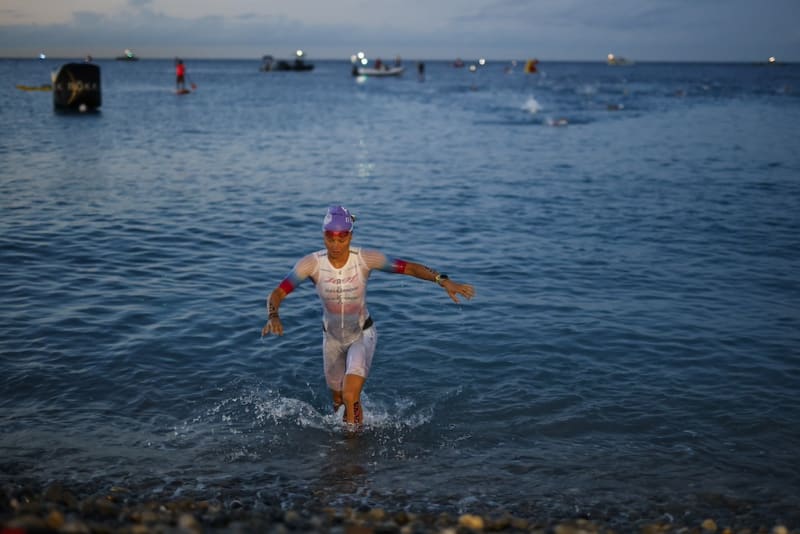
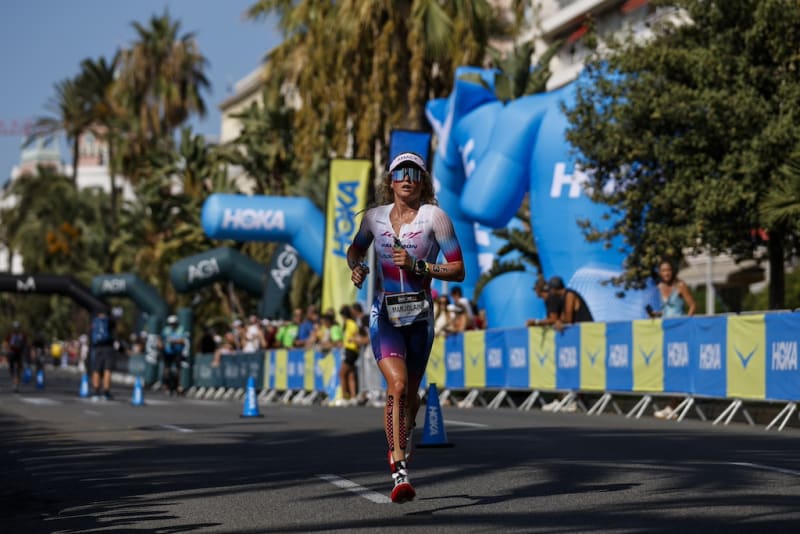
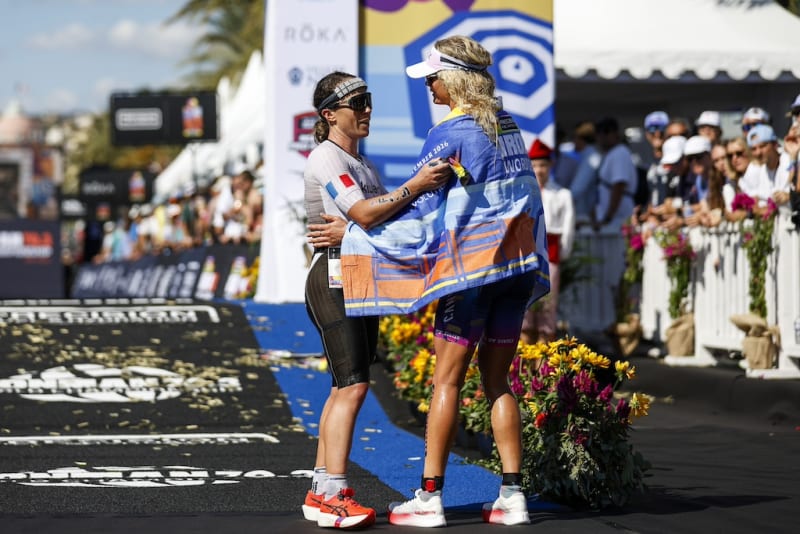
Initially disappointed by her fifth place at the latest IRONMAN 70.3 World Championship in Nice, where she was within touching distance of the podium before fading on the final half-marathon, French triathlete Marjolaine Pierré can still take plenty of satisfaction from another top-five finish at a major international event. At just 26, the Salomon athlete is showing that she will be a force to be reckoned with on the IRONMAN circuit for years to come. Before flying to Hawaii for the upcoming IRONMAN World Championship, she looked back on her race in Nice with triathlons.com.
Marjolaine, you were extremely disappointed immediately after missing out on the podium at the IRONMAN 70.3 World Championship in Nice. After a few days, how do you assess that fifth-place finish?
I’m still disappointed. It’s hard to train so much for one particular day and then miss the goal you set yourself. You commit 200% to this kind of race, you make sacrifices, and when things don’t go the way you hoped, it’s always difficult to deal with. But you quickly put things into perspective. There are worse things. I’m healthy, everything is fine, I was able to race, and I’m still happy to have had the chance to experience a home World Championship in Nice. It’s a bit like the end of a summer camp: you pack everything away at the end of the week and realise it’s over, that you have to say goodbye to your friends. That also adds another layer to the disappointment: knowing that a chapter is closing (*).
So what went wrong on race day?
On the bike, I didn’t feel good on the climbs. I was really strong on the flat and on the descents, which I had memorised really well, but on the climbs I had no power, or at least not the power you need to keep moving forward properly. I could feel that my legs weren’t responding. I didn’t want to look at my time on the Col de Vence, a climb I regularly do in training. That’s frustrating too: when you know the course well, you know exactly what you’re capable of on each section, and you quickly know whether you’re having a good day or not.
Do you have any explanation for that lack of energy on the bike?
It’s difficult to explain. I had tried to prepare as well as possible. I picked up a minor virus 10 days before the race, the kind you get in autumn or towards the end of a build, and I knew I was still fighting it. These are the little things you try to control but can’t really master. There was probably an accumulation of small factors that led to that lack of energy.
On the run, all I could think about was stopping and lying down. I was completely wiped out; my body just wanted to take a nap. There are even sections of the run I don’t remember.
Did those sensations on the bike affect you mentally before you started the run?
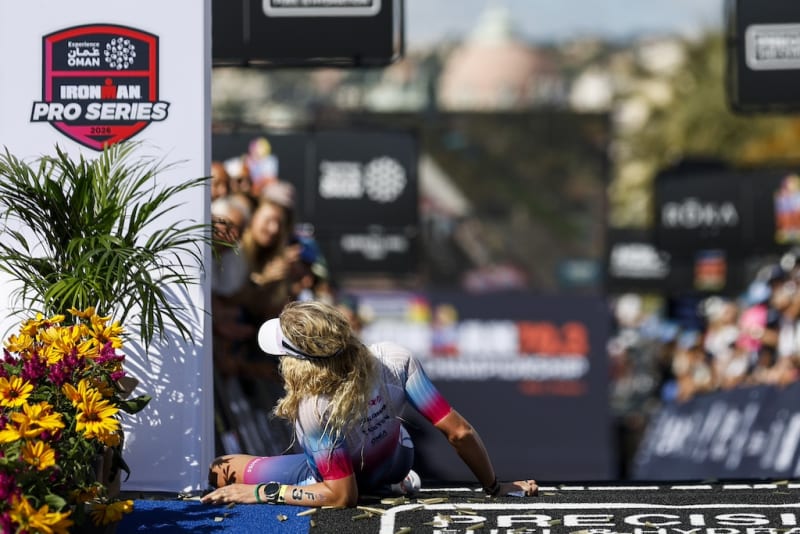
No, I stayed really focused. A triathlon isn’t over until the run is finished, and I never told myself it was done. I kept fighting, and I was happy to come into T2 in second place. I was 4:30 down, so that was quite a lot, but I had been eight minutes behind at the top of the Col de Vence, so I was pleased with myself and really wanted to keep fighting. But when I set off on the run, all I wanted to do was collapse, which is what I did on the finish line. During the half-marathon, all I could think about was stopping and lying down. I was completely wiped out. It wasn’t hypoglycaemia, more a general fatigue; my body just wanted to take a nap. There are even sections of the run I don’t remember. For example, around the “ILOVENICE” sign, I’m not really sure whether I went along the Promenade or the road. It’s like a blank.
Had you ever experienced sensations like that before?
Not really, apart from once when I became dehydrated and then felt faint during a race. I think I tried to push that limit as far as I could, but at the same time I was losing places, so it was mentally difficult to stay engaged. I had dreamed of that podium and I was on it, so losing it was hard. I tried to hang on and at least stay in the top five.
The field was exceptionally deep. Were you able to enjoy the battle with the other women at least?
No, and that’s another reason I’m a little disappointed. I was never able to respond to the attacks, and when people passed me, I couldn’t get into the fight. I didn’t have the energy or the punch. I was completely flat. But with such a strong field, it was very difficult to predict where you would finish because there could be good or bad surprises. It’s still a good thing to have continued producing strong results and to show a certain consistency.
 © Pablo Blazquez Dominguez/IRONMAN
 © Pablo Blazquez Dominguez/IRONMAN
 © Pablo Blazquez Dominguez/IRONMAN
 © Pablo Blazquez Dominguez/IRONMAN
You introduced something new into your preparation by spending five weeks at altitude in Font-Romeu before Nice. What did you take from that experience?
Only positives. We were at a specialised training centre with all the facilities in one place, open from Monday to Sunday, from 8 a.m. to 8 p.m., and sometimes from 6 a.m. to 8 p.m. That was really valuable because at that time of year in Nice, you have to use the municipal pool and work around its opening hours and days. When those constraints are added to the demands of training, life becomes more complicated. So it was great to have that freedom in our training. We also went there for the benefits of altitude.
Do you think the lack of energy you felt during the race could have been linked to the altitude or to coming back down from Font-Romeu? We know that sometimes timing can come down to just a few days.
It’s true that you need to spend a lot of time at altitude to really understand how your body responds. It probably played a role in the fatigue I felt. But I also think the virus may have shifted my peak fitness. It’s a combination of very fine margins, and you have to get each one right to optimise a performance and a preparation.
You’re only 26, almost 27, and still very young compared with the leading athletes in the sport. Is that reassuring?
Yes, of course. All my rivals have raced far more than I have. Some have competed over the Olympic-distance format and have had support and guidance for decades. I didn’t have that opportunity. I learned everything by myself, never received any help from the federation in the early years, and built myself through my results. I first had to achieve strong performances before I could ask for support. That inevitably takes more time. In a way, I’ve had to unlock each level as I went.
I’ve only just started increasing my running volume. Until then, I was doing around 40 to 50 km a week, and I moved up to 60 to 80 km in Font-Romeu. That was a first for me, whereas my rivals have been doing it for years.
Do you feel you still have room to improve, and can you see yourself racing on the IRONMAN circuit for a long time yet?
Yes, absolutely. I’m nowhere near my limit. My training volume isn’t particularly high, and that was a deliberate choice because I didn’t want to skip steps. It was almost essential to progress gradually and not move faster than I was ready for. So I really see myself at the beginning or in the middle of my development, which is exciting because I still have plenty of things to try and do. But they need to happen at the right time and in the right way. You also have to be patient and accept that you’ll sometimes get beaten. I know I’ll have to work more on both intensity and volume.
 © Pablo Blazquez Dominguez/IRONMAN
 © Pablo Blazquez Dominguez/IRONMAN
 © Pablo Blazquez Dominguez/IRONMAN
 © Pablo Blazquez Dominguez/IRONMAN
When will you move that needle?
I haven’t had a stress fracture for two years, so we started increasing my running mileage in Font-Romeu. Until then, I was doing around 40 to 50 km a week, and I moved up to 60 to 80 km. It was a first for me, whereas my rivals have been doing that for years. I’m a little behind in that area, but I’m starting to focus on it.
You’ve suffered a number of stress fractures in recent years. Why and how did that happen, and do you feel you’re through it now?
It happened in 2021, when I started triathlon during the Covid period. I had no real knowledge and kept training more and more, just for fun, while also studying accounting. I quickly fell into an energy deficit. I lost my menstrual cycle and told myself it would come back, but then I stopped thinking about it. I was doing lots of things at once, with no time for myself or to pay attention to what was happening in my life and in my body. I was always in overdrive and never took a break. I lost a lot of weight, suffered stress fractures, became amenorrhoeic and developed disordered eating. It was all connected. I had to understand how my hormones worked and learn to recognise the signs that I was in shape or struggling. It was a long and very formative process, and I lost a lot of time. Or maybe I gained time in the end, because I know myself much better today. I also learned to race without being properly trained, and that made me mentally stronger.
Last year, I was overwhelmed by the scale of the IRONMAN in Hawaii. This year, I really want to go back with a lighter mindset.
In less than a month, you’re expected to be on the start line of the IRONMAN World Championship in Kona, Hawaii. What are your ambitions?
Little by little, day by day, I’ll get back to the key sessions that will put me on the road to Kona. I’ll gradually add training load, do longer sessions and plenty of heat training to get used to Hawaii’s heat and humidity, because that’s a very important factor there. I also need to recover from Nice, but because I wasn’t feeling very well, I didn’t push myself to the limit. So I’m actually quite happy with my recovery and should be able to get in two solid weeks of training before heading to Kona to acclimatise.
What did you take from your experience in Hawaii last year?
It was a very tough race. Physically, I was in great shape, but I was overwhelmed by the event (**). I think it’s very difficult to perform well there on your first attempt, and I really want to go back with more… lightness, let’s say.
 © Talbot Cox/IRONMAN
 © Talbot Cox/IRONMAN
Is that race profile and atmosphere a good fit for you?
Yes, it reminds me of Réunion, where I grew up. I love the heat and have always trained in hot conditions, so it’s not a factor that bothers me. The Kona course is very tough on the bike, even though it’s fairly fast. I also like fast sections. I’m not just a climber, so honestly, I can’t wait to get there!
(*) Nice was initially due to host the IRONMAN 70.3 World Championship in 2028 and 2030. Following a budget decision by the new municipal administration, that will no longer be the case.
(**) She finished 32nd in the women’s race.
Marjolaine Pierré at a glance
Born on 29 October 1999 in Reims
Two-time winner of IRONMAN 70.3 Pays d’Aix, in 2025 and 2026.
Winner of IRONMAN Portugal in 2023.
Two-time World Triathlon Long Distance World Champion, in 2023 and 2025.
Fourth at IRONMAN Hamburg in 2026.
Fifth at the 2026 IRONMAN 70.3 World Championship in Nice.
Fourth at the 2024 IRONMAN World Championship in Nice.
Fifth at the 2025 IRONMAN 70.3 World Championship in Marbella.
More articles
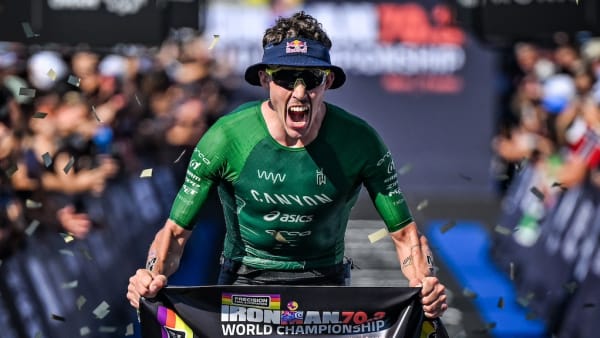
Hayden Wilde wins a wild IRONMAN 70.3 World Championship
Hayden Wilde wins the IRONMAN 70.3 worlds in Nice ahead of Kristian Blummenfelt and Jelle Geens.
Sun, September 13, 2026
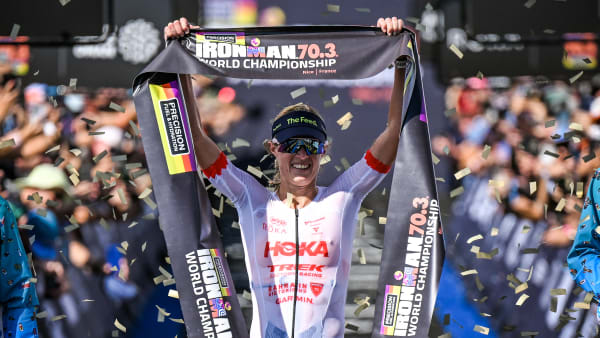
Taylor Knibb claims fourth IRONMAN 70.3 world title in Nice as Marjolaine Pierré finishes fifth
Taylor Knibb claimed her fourth IRONMAN 70.3 world title in Nice after a dominant bike leg.
Sat, September 12, 2026

IRONMAN Pro Series 2027 calendar unveiled
The 2027 IRONMAN Pro Series calendar brings the world’s best together across 16 races, with $1.7 million in prize money on offer.
Thu, September 10, 2026