
IRONMAN World Championship: Vincent Luis wins world title in final race of his career, Taylor Knibb triumphs in Kona
 © IRONMAN
Vincent Luis made history overnight by becoming the first Frenchman to win the IRONMAN World Championship in Kona, Hawaii. It was a remarkable achievement for the 37-year-old, who was discovering the legendary Kona course for the first time and racing the final event of his professional career. A fitting send-off for the two-time Olympic-distance world champion. On his Hawaiian debut, Pierre Le Corre also delivered a first-rate performance to finish fifth. In the women’s race, American Taylor Knibb claimed her first IRONMAN world title in Hawaii, while France’s Anne-Sophie Pierre finished ninth.
Frenchman Vincent Luis achieved something in Hawaii overnight that is surely one of the hardest things for any elite athlete: ending a career at the very top, with a victory in the ultimate triathlon challenge, the IRONMAN World Championship in Hawaii. And he did it at his first attempt, on a course so unique that athletes often say it takes several tries to master all its variables. But the intelligence and experience of the former two-time Olympic-distance world champion, combined with his command of a punishing course, carried him to a richly deserved crowning moment after a complete and distinguished career.
 © IRONMAN
 © IRONMAN
 © IRONMAN
 © IRONMAN
The Frenchman was in the mix throughout a hot, humid day in Hawaii, staying in touch with the front group through the swim and bike while taking care not to get carried away by an early rush of confidence that could have seen his challenge burn out.
Blummenfelt stays in touch with the leaders on the swim
In an unusually rough ocean, a large group of favorites, already watching one another closely, stretched out over the 3,800m swim.
Germans Jonas Schomburg, Patrick Lange and Wilhelm Hirsch, South African Jamie Riddle, Belgian Marten Van Riel and Dutchman Menno Koolhaas were among those at the front. The aim was clear: build as much of a gap as possible over dangerous Norwegian Kristian Blummenfelt. After being beaten at Challenge Roth and then at the 2026 70.3 World Championships following a costly deficit before the run, Kristian Blummenfelt knew his rivals would probably use the same tactic against him. He therefore managed to stay in the leaders’ wake through the Hawaiian swim, never allowing himself to fall more than 30 seconds back.
 © IRONMAN
 © IRONMAN
At the turnaround, 20 to 30 swimmers were covered by just 30 seconds. France’s Pierre Le Corre was showing at the front alongside Wilhelm Hirsch, Jamie Riddle, German Frederick Funk, Marten Van Riel and Jonas Schomburg.
Blummenfelt exited the water just 31 seconds behind Marten Van Riel, the first man onto dry land in 48:17, ahead of Menno Koolhaas and a group containing Wilhelm Hirsch, American Matthew Marquardt, Pierre Le Corre, Patrick Lange and Sam Laidlow, all within 30 seconds of the Belgian leader.
The next group included former Norwegian world champion Gustav Iden, already almost two minutes down on the leaders.
Jonas Schomburg and Magnus Ditlev hit the bike at full speed
A frantic first transition saw Menno Koolhaas head out onto the bike course first, closely followed by Wilhelm Hirsch, Marten Van Riel, Vincent Luis and Patrick Lange. Sam Laidlow, meanwhile, lost almost a minute putting on his socks.
Jonas Schomburg, starting 41 seconds behind Koolhaas, was the first to attack, as usual. But Matthew Marquardt, Kristian Blummenfelt, Sam Laidlow, Gustav Iden, Italian Gregory Barnaby and Dane Magnus Ditlev gradually got moving as well…
The early-morning cloud and rain gave way to brilliant sunshine and stifling humidity. The conditions appeared to cause serious problems for some competitors, notably Patrick Lange, who was forced to stop after appearing to struggle, and Marten Van Riel, who was seen vomiting. The German briefly resumed riding, but the three-time IRONMAN world champion and course-record holder eventually had to withdraw.
A worthy successor to Germany’s Uberbikers, Jonas Schomburg took control of the race, but the chasing group was strong. Sam Laidlow, Matthew Marquardt, Gregory Barnaby and Vincent Luis began clawing back time on Queen Ka’ahumanu Highway.
 © IRONMAN
Magnus Ditlev and Gustav Iden caught that group at kilometer 88. After trailing by more than 3:30 at one point, Kristian Blummenfelt also accelerated and managed to rejoin the leaders.
At the Hawi turnaround, Jonas Schomburg led Matthew Marquardt by 52 seconds. Magnus Ditlev (1:20 back), Gregory Barnaby (1:21), Jamie Riddle (1:32), Gustav Iden (1:58), Vincent Luis (2:01) and Marten Van Riel (2:05) were in pursuit. Sam Laidlow (2:19) and Kristian Blummenfelt (2:32) were also close enough to pose a threat.
The complexion of the race changed radically as the riders began the descent from Hāwī, looking to make the most of the favorable winds that had slowed them on the climb out.
Jonas Schomburg was hit by cramps at kilometer 110, allowing Matthew Marquardt, Magnus Ditlev and Gregory Barnaby to pass him. By kilometer 132, Schomburg had slipped to 10th, while Sam Laidlow, Vincent Luis, Gustav Iden and Kristian Blummenfelt pulled clear.
Matthew Marquardt, then in the lead, received a yellow card for drafting (riders must remain 20 meters back to avoid benefiting from the slipstream of the athlete ahead) and had to serve a penalty, dropping from first to ninth.
Magnus Ditlev therefore reached the second transition in front, completing the 180 km bike in 4:06:47.
Sam Laidlow arrived at T2 in second, 1:27 down. Matthew Marquardt’s presence just behind him was more surprising: the American had limited the damage from his penalty remarkably well and was now only 2:23 behind the leader.
Gregory Barnaby racked his bike in fourth (3:34 back), ahead of Kristian Blummenfelt (6:02) and Vincent Luis (6:04). Gustav Iden was handed a penalty and reached T2 in ninth, 9:19 behind the leader.
Luis’s cautious strategy pays off
When Magnus Ditlev left the second transition with a narrow lead over Sam Laidlow, most expected the Frenchman to begin hunting down the Dane within the opening miles of the marathon. But the marathon had barely begun when Laidlow was seen walking near one of the first aid stations. He appeared to be holding and shaking his legs in an attempt to release the tension. Matthew Marquardt passed him to move into second, followed by Gregory Barnaby. Later, speaking to the official YouTube channel, Laidlow said he was suffering from iliac artery endofibrosis, which reduces blood flow and causes pain.
Magnus Ditlev was now well clear and in an excellent position to claim his first IRONMAN world title, having finished second here in 2024 and third the previous year in Nice.
But the suspense was far from over. Five men could still take the crown from Ditlev: Matthew Marquardt, Gregory Barnaby, Vincent Luis, Kristian Blummenfelt and Gustav Iden.
 © IRONMAN
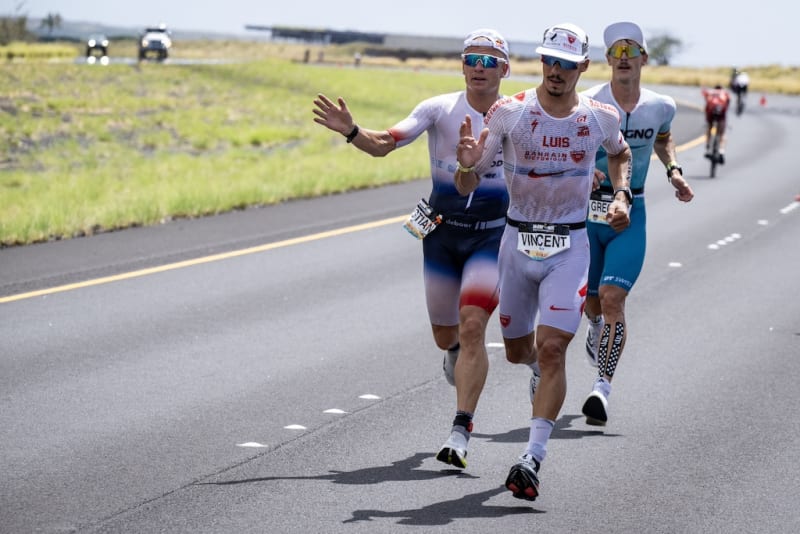
At kilometer 20, Magnus Ditlev still held a comfortable lead: 4:26 over Matthew Marquardt, 4:41 over Kristian Blummenfelt, Vincent Luis and Gregory Barnaby, who were running together, and 6:44 over Gustav Iden. Iden was rapidly climbing the standings, posting the fastest splits and putting himself firmly back in the podium conversation.
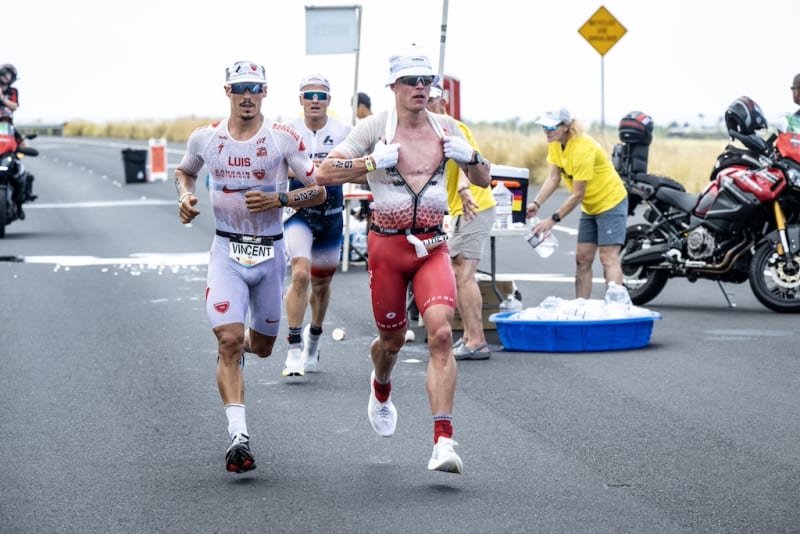
By kilometer 30, Magnus Ditlev was clearly beginning to fade and his pursuers sensed an opportunity. Against all expectations, it was not Kristian Blummenfelt who launched the attack, but Vincent Luis.
 © IRONMAN
The Frenchman produced an impressive surge and dropped the Norwegian. Matthew Marquardt and Gustav Iden also moved ahead of Blummenfelt, who gradually slipped down the standings.
Vincent Luis quickly caught Magnus Ditlev. The Dane began walking through the aid stations and stopping to collect ice for his cap.
Ditlev made repeated stops on the scorching asphalt. Vincent Luis eventually passed him, soon followed by Gustav Iden, who became his main rival.
For a few moments, it looked as though the Norwegian might catch the Frenchman and force a tense sprint finish. But Iden had spent an enormous amount of energy fighting his way back into contention, and his attack eventually ran out of steam.
Vincent Luis completed the marathon in 2:38:36 to take the long-awaited victory in 7:47:27. It came after enormous sacrifices since January, including losing 10 kilos and weighing in at 65 kg for the race. He told SLOT magazine several years ago: “Triathlon is the Olympics and Hawaii. The rest is just literature.” Although the man from Vesoul never managed to win an individual Olympic medal, he achieved his goal in Hawaii at his first and last attempt. No French professional had done that in Hawaii since the inaugural edition in 1978.
Could this historic victory make him reconsider his announced retirement? Vincent Luis had already answered that question at the post-race press conference:
I asked myself that question, wondering what I could do better with another year. And the answer is: nothing. I could get some big contracts now, sure, but money has never been a driving force for me. I could carry on and get injured, spend three months sidelined. So I don’t really see the point.
 © IRONMAN
Gustav Iden, who ran a 2:36:58 marathon, finished second in 7:49:03. The three-minute bike penalty therefore proved extremely costly. Third place went to the surprise package Matthew Marquardt.
The other French rookie, Pierre Le Corre, fought his way back to an outstanding fifth place. Arnaud Guilloux was the third French Pro finisher, taking 34th.
 © IRONMAN
MEN’S TOP 10
1) Vincent Luis | (France) | 7:47:27 |
2) Gustav Iden | (Norway) | 7:49:03 |
3) Matthew Marquardt | (USA) | 7:49:59 |
4) Gregory Barnaby | (Italy) | 7:51:02 |
5) Pierre Le Corre | (France) | 7:53:29 |
6) Sam Long | (USA) | 7:55:21 |
7) Jonas Schomburg | (Germany) | 7:56:42 |
8) Kristian Blummenfelt | (Norway) | 7:58:07 |
9) Youri Keulen | (Netherlands) | 7:58:26 |
10) Menno Koolhaas | (Netherlands) | 7:58:55 |
A chaotic women’s race in Kona
In the women’s race, impressive American Taylor Knibb, a four-time IRONMAN 70.3 world champion, won over the full distance one year after abandoning the race during the final marathon while leading.
Her victory came after an extraordinary turnaround in the final miles of the marathon. Knibb passed defending champion Norwegian Solveig Løvseth in the final mile, when Løvseth was no longer able to run. With victory almost within reach, the defending champion suddenly slowed dramatically, collapsing several times onto the asphalt.
 © IRONMAN
Germany’s Laura Philipp finished second, as in 2025, while Switzerland’s Julie Derron completed the podium on her first visit to Kona, despite a three-minute drafting penalty on the bike.
Lucy Charles-Barclay leads the swim, Philipp loses ground
Britain’s Lucy Charles-Barclay emerged first from the water for the seventh time in seven Kona appearances. She came out of an increasingly rough ocean in 51:29, with a 1:26 lead over Taylor Knibb.
 © IRONMAN
The Brit had predicted that difficult conditions could work in her favor and wasted no time putting her rivals under pressure. Taylor Knibb initially set the pace in the chase group before being joined at the front by Spaniard Marta Sanchez. The heavy swell dropped several favorites, including Briton Kat Matthews and Norway’s Solveig Løvseth. Swiss athlete Julie Derron stayed well placed on her Kona debut. Of the favorites, only Laura Philipp had a significant deficit out of the water. The German was 30th out of the swim, 8:34 down before the bike began.
Knibb takes the lead on the bike from Charles-Barclay
The roads around Kona were wet, but dried quickly as the heat and humidity rose. Taylor Knibb, who opted for a ventilated road helmet rather than an aero time-trial helmet, gradually erased her deficit and passed Lucy Charles-Barclay shortly after kilometer 50.
The Brit refused to yield, drawing level and briefly retaking the lead before Knibb responded. The two women then traded the lead.
Behind them, Swiss athletes Imogen Simmonds and Julie Derron led the chase, but the headwind climb to Hawi split the pursuing group. Kat Matthews lost significant ground, while New Zealander Hannah Berry, Canadian Paula Findlay and Austrian Lisa Perterer remained poised to capitalize.
Julie Derron was then given a three-minute drafting penalty, putting her more than seven minutes behind the leader.
Taylor Knibb eventually opened a gap on the return to Kona. With 20 km to go to the transition area, she led Lucy Charles-Barclay by 2:30 before completing the course in 4:40:07, nine minutes slower than last year.
 © IRONMAN
Lucy Charles-Barclay posted the third-fastest bike split, behind Solveig Løvseth, who finished the bike in third, 4:50 off the lead.
Knibb wins after an incredible turnaround
Taylor Knibb began the marathon with a 3:06 lead over Lucy Charles-Barclay. Laura Philipp, 10th and almost 10 minutes down, faced a much tougher task, as did Julie Derron, who was eighth and more than nine minutes back at the start of the final 42 kilometers.
Through the first half of the marathon, Taylor Knibb appeared to be managing her lead. After 10.5 km, she was still 2:40 ahead of Lucy Charles-Barclay, while Solveig Løvseth was 3:43 back.
 © IRONMAN
Behind them, Laura Philipp was mounting a superb comeback. The German had already moved into fourth, while Julie Derron was going through a difficult patch and had slipped to seventh.
Lucy Charles-Barclay’s dream ended around kilometer 28, almost exactly where her race had unraveled the previous year. Running in third, the Brit stopped. Her withdrawal was later confirmed after she had built her entire season around this day.
Taylor Knibb was also beginning to struggle and appeared to vomit as Solveig Løvseth closed in. With around 8 km to go, the Norwegian took the lead at the aid station where Vincent Luis had passed Magnus Ditlev in the men’s race. Knibb immediately tried to respond, but Løvseth opened a gap. With her advantage now over a minute, the defending champion appeared headed for another world title and victory in the IRONMAN Pro Series standings.
But less than 1.6 km from the finish, Solveig Løvseth suddenly found herself unable to run and struggling even to walk. Taylor Knibb passed her to retake first, followed by Laura Philipp, as the Norwegian’s hopes collapsed with the finish line almost in sight.
Taylor Knibb crossed the finish line looking stunned, claiming her first IRONMAN world title in circumstances that reversed the dramatic script of the previous year. Then, her own collapse in the final miles had helped clear the way for Solveig Løvseth.
Laura Philipp finished second once again, three minutes back, after a perfectly controlled marathon. Julie Derron found the resources to accelerate late and secure third, almost 10 minutes down.
For France, the surprise came from Anne-Sophie Pierre. On her first appearance in Hawaii, the Frenchwoman finished in the top 10, taking ninth. Pierre is only the third Frenchwoman in history to achieve that result in Hawaii, after the Mouthon sisters did so around 30 years ago: Isabelle finished second in 1995, with Béatrice third that same year. Pierre now holds the fastest time by a Frenchwoman in Hawaii, 9:03:49. She finished just behind defending champion Solveig Løvseth, who, despite suffering further setbacks all the way to the finish, managed to take eighth.
The second Frenchwoman in the results was age-grouper Lou Prigent, age-group world silver medalist, 25–29 world champion and 28th overall woman. She finished ahead of the third French Pro athlete, Nikita Paskiewicz, 41st overall among the women. Marjolaine Pierré withdrew during the marathon.
 © IRONMAN
WOMEN’S TOP 10
1) Taylor Knibb | (USA) | 8:36:29 |
2) Laura Philipp | (Germany) | 8:39:34 |
3) Julie Derron | (Switzerland) | 8:46:25 |
4) Kat Matthews | (Great Britain) | 8:49:38 |
5) Imogen Simmonds | (Switzerland) | 8:51:44 |
6) Lisa Perterer | (Austria) | 8:52:54 |
7) Hannah Berry | (New Zealand) | 8:59:41 |
8) Solveig Løvseth | (Norway) | 9:02:09 |
9) Anne-Sophie Pierre | (France) | 9:03:49 |
10) Grace Thek | (Australia) | 9:06:37 |